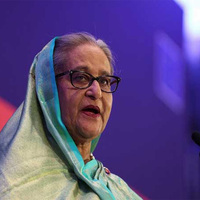


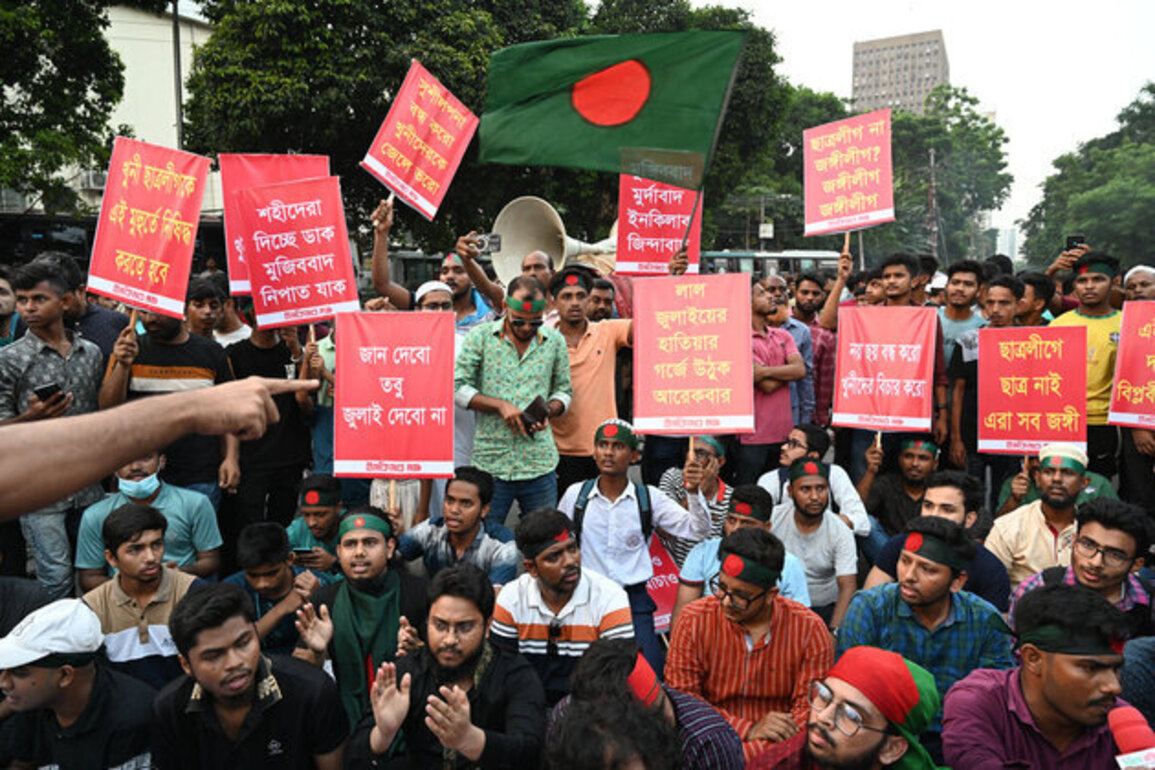
Ousted Bangladesh prime minister Sheikh Hasina refused to apologize for the bloody crackdown on street protests that led to her downfall last year, and told international media outlets that she has no intention to leave India. Last week, Sheikh Hasina from her safe house somewhere in Delhi, India gave written interviews to Reuters, The Independent, and French news agency AFP.
The interviews via email with international outlets were her first media engagements since her autocratic regime collapsed during the Monsoon Revolution. She spoke her mind, planned on her exile, her political party, Awami League, the upcoming election sans Awami League, and, of course, critiquing the Interim Government, describing it as an illegal government. She blamed the Yunus government was sowing the seeds of further division in her country.
The three international media which were published on the same day the 78-year-old former leader remained defiant in her exile, rejecting charges of crimes against humanity and describing her ongoing trial as politically motivated. Despite her failure to hold free, fair, and inclusive elections in three consecutive sham polls during her 15-year rule, she has now demanded that the Interim Government should hold an inclusive election.
The same opposition, Hasina once castigated, the Bangladesh Nationalist Party (BNP) is seen as the frontrunner, while Jamaat-e-Islami, the Sunni Muslim-majority countrys largest Islamist party, is rising in popularity during post Hasina. The Election Commission suspended the Awami Leagues registration in May. Earlier, the government banned all party activities, citing national security threats and crimes against humanity probe into senior Awami League leaders.
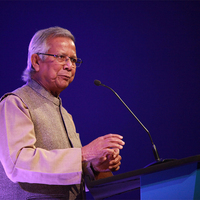
She warned that the ban on her Awami League by the interim government of Nobel laureate Muhammad Yunus was deepening a political crisis in the country of 170 million people, ahead of elections slated for February 2026. Millions of supporters of Bangladeshs Awami League will boycott next years national election, Hasina told Reuters from her exile in India.
Hasina, 78, said she would not return to Bangladesh under any government formed after elections that exclude her party, and plans to remain in India to live quietly and freely, where she fled in August 2024 following a deadly student-led uprising. She added that she had no intention of seeking asylum beyond India (in a third country).
Hasina is in exile in New Delhi for the second time. Earlier, she stayed for six years, from 1975 to 1981. Later, she returned to Bangladesh as president of Awami League, and in 1996, she was elected Prime Minister for the first time. The 78-year-old former leader remained defiant, rejecting charges of crimes against humanity and describing her ongoing trial as politically motivated.
The Prosecutors of the International Crimes Tribunal, a Bangladesh war-crimes court, are seeking the death penalty for Hasina, accusing her of crimes against humanity by ordering the use of lethal force against student protesters, resulting in up to 1,400 deaths. In her AFP interview, Hasina rejected the accusations of crimes against humanity, insisting they were not supported by any evidence and that the tribunal was appointed by an administration that included her political opponents.
Hasina contested the Office of the United Nations High Commissioner for Human Rights (OHCHR) death toll claim during the July Uprising in 2024, saying that the 1,400 figure is useful to the ICT for propaganda purposes but is probably inflated. Prosecutors have sought the death penalty for Hasina, accusing her of ordering lethal force against protesters in July and August 2024, when as many as 1,400 people were killed and thousands were injured, according to what the United Nations described. Hasina is defended in ICT by a state-appointed lawyer, but said she would only recognize an impartial process, such as one at the International Criminal Court (ICC).
Hasina, meanwhile, has defied court orders to return to attend her trial on whether she bears command responsibility for the deadly crackdown, charges amounting to crimes against humanity under Bangladeshi law. A verdict is due on 13 November. In response to AFP, Hasina also condemned her crimes against humanity trial as a jurisprudential joke, adding she believed a guilty verdict was preordained. Her critics, including interim officials and human rights lawyers, say she bears command responsibility for the use of lethal force. Chief prosecutor Tajul Islam described her as the nucleus around whom all the crimes were committed, urging the court to impose the death penalty if found guilty.
Bangladeshs premier English newspaper, the Daily Stars own investigations found that Hasina had personally authorized the use of lethal weapons. The newspaper had published a leaked phone recording from 18 July 2024 where Hasina tells her nephew, former Dhaka South Mayor Fazle Noor Taposh, I have given instructions, now I have given direct instructions; now they will use lethal weapons. Wherever they find them [protesters], they will shoot directly. The charge that I personally directed security forces to open fire on crowds is bogus, Hasina told AFP, while conceding that some mistakes were certainly made within the chain of command. Theyve been brought by kangaroo courts, with guilty verdicts a foregone conclusion, she told Reuters, adding that she would neither be surprised nor intimidated if she were sentenced to death.
She told the Independent that she mourns every child, sibling, cousin, and friend we lost as a nation, but refused to issue a formal apology, arguing that the unrest was manipulated by her political rivals to topple her government. I mourn the lives we lost, but I reject the false allegation that I ordered police to shoot demonstrators, she said.
Rights groups, including the Human Rights Watch and Amnesty International, long accused her government of a litany of abuses, including the murder of rivals, suppression of opposition parties, rigged courts, and one-sided elections. In response to AFP, Hasina said her priority now was the welfare and stability of Bangladesh, while her party explores legal and diplomatic avenues to contest its exclusion from the political process.Yunus must reinstate the Awami League to give Bangladeshis the choice they deserve. To conclude, Awami Leagues return to power, in any foreseeable future, remains a political impossibility, Abu Jakir wrote in a news portal, Bangla Outlook.
This article was published in theStratheia Policy Journal, Islamabad, Pakistan on 2 November 2025
Saleem Samad